
QOTW: Carney lobs a double-barrelled doozy at Jeremy Hansen
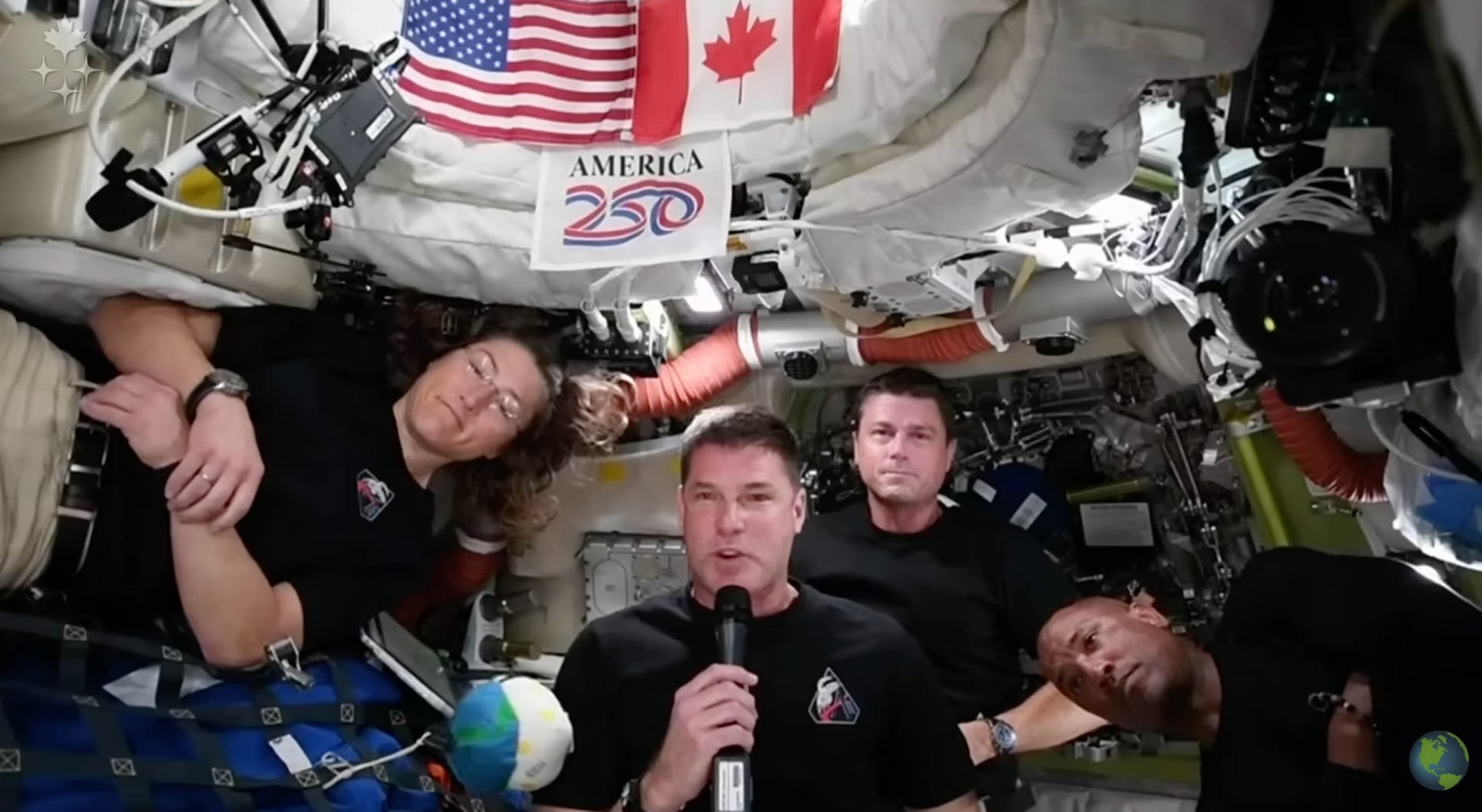
Jeremy Hansen, centre, floats in space with a microphone while answering questions from Prime Minister Mark Carney during a live conversation on Wed., April 8, 2026. With him are, from left, crewmates Christina Koch, Reid Wiseman and Victor Glover. (Credit: YouTube/Canadian SpaceAgency)
This week’s question comes from none other than Canadian Prime Minister Mark Carney. To call it a question, singular, does it an injustice. This was a prime example of what we call “multiple questions” in media training and Q&A skills coaching.
The set-up
The crew of Artemis II is taking questions from Canadians in a live stream. The Prime Minister comes in as “a special guest” and, after some friendly banter and questions about maple syrup vs. Nutella on pancakes, asks this:
“I’ll squeeze in two questions. They’re both serious questions. The first one was: Jeremy, you said the other day that this mission is a risk for a good reason. Which really struck me. And it struck me, as well, when [during] the countdown, when there were some tolerances, and mission control had to decide that it was risky and it was good to go and everyone signed off. So you’re taking risks for a good reason. And I just wonder, maybe expand on that a bit. You know, you’ve got lots of young people watching and inspired, and the challenge that there is and it’s a positive challenge for this generation. But the other question, which I’ll squeeze in, is: we’ve been following here, the wake-up songs from Sleepyhead to Tokyo Drifting. My daughter’s making a playlist, so she wants to get some feedback on your favourites, your favourite wake-up songs.”
The analysis
This is classic multiple questions. This happened all the time when I worked as a journalist. There is the original question, which comes from the reporter themselves, and a separate question that comes from a different reporter, region or show. In this case, both questions are geared to a younger audience, but the second one is clearly in service to his daughter. (Awesome, by the way!)
Multiple questions also happen when the person asking them is speaking faster than they’re thinking. They’ve asked an initial question, but then think of another related, possibly better question. Then, because we tend to think in threes, they ask another question.
The advice
For many people, multiple questions are a real challenge. Our brain hears the first question and starts to formulate a response when, all of a sudden, our brain is asked to go in a different direction to respond to the second one.
The first tip, of course, is to listen to all of the questions; let them wash over you. Then, take a moment to breathe and think: which of these questions do I like best? Which is easier to answer? Which one’s answer will resonate most with my audience?
The next tip is not to worry about remembering every question — but this depends on the context. If the stakes and visibility are high, take notes if that will help you keep track of the questions. In other cases, however, it’s okay to assume the person asking the questions doesn’t remember them all. If they do, they’ll remind you!
The answer
In this case, Jeremy Hansen remembered both questions and answered the second question, about the playlist, first. He passed the mic around to his crew mates, who each weighed in; this gave him time to think about his response to the other question:
“We do think risk is necessary, but calculated risk, well-thought-out risk, and risk that you balance with others. And so for youth that are making those decisions, do it in collaboration with others. People will point out when you’re out over your skis, so you have to be smart about how you take risk. But as a country we have to be willing to have some failures, and we fail in the space program but we just assure ourselves we’re not going to stay or rest in those failures. We’re going to push through them.”
All in all, a great answer that will connect with and, likely, inspire that younger audience.
Bonus tip: If you’re going to say something like “out over your skis,” be sure your audience will understand it.
